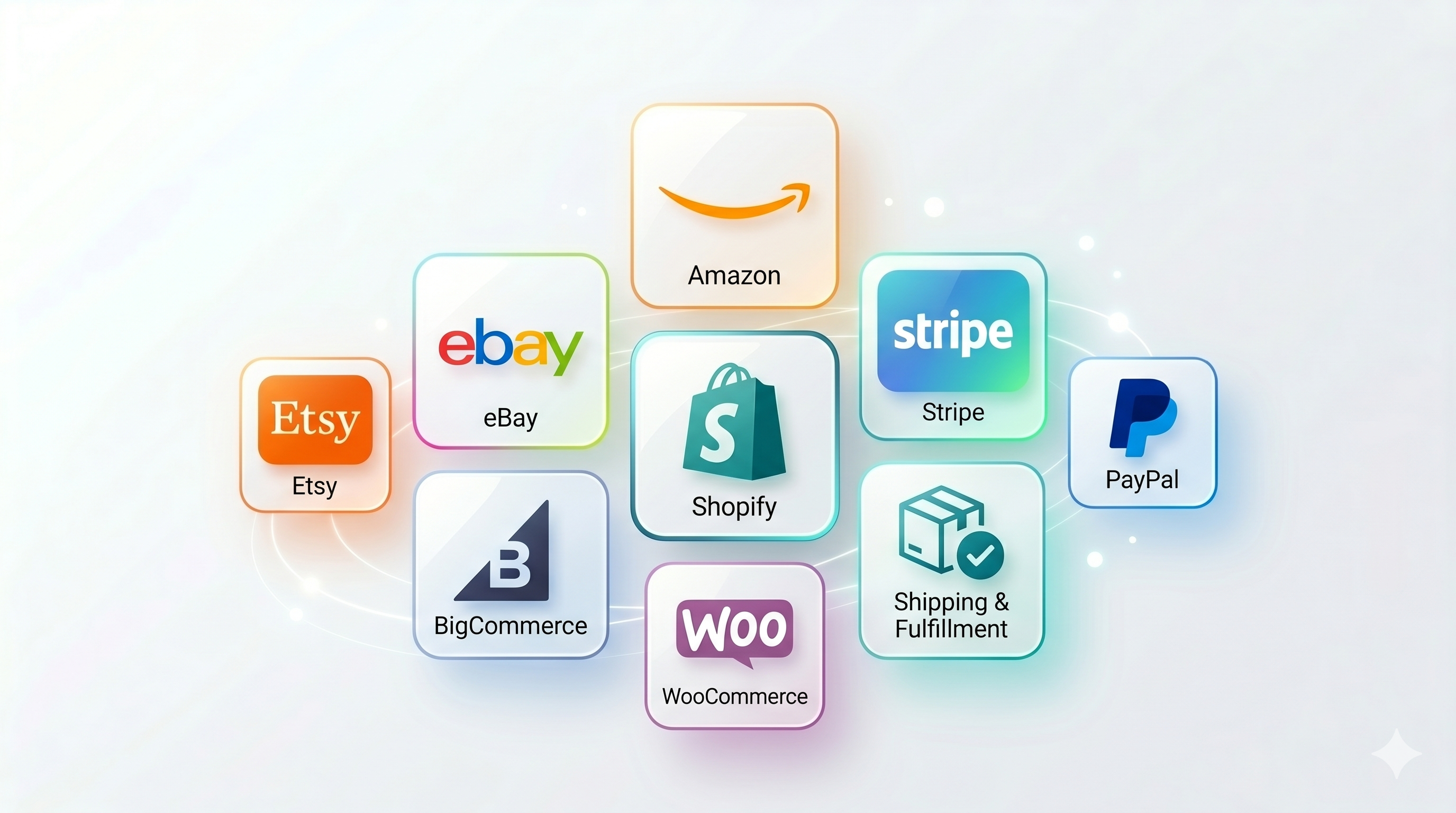
The 2026 Ecommerce Stack Field Guide
Shopify, BigCommerce, WooCommerce, Klaviyo, Gorgias, Tidio, Stripe, Smile.io — the modern ecommerce stack is more about the supporting layer than the platform. Here's the honest map of what each one is actually for.
Ecommerce in 2026 isn't about picking a platform — Shopify won the consumer-friendly tier, BigCommerce holds enterprise, WooCommerce holds the customization-heavy tail, and the meaningful question is the supporting stack. Email marketing, customer support, payments, loyalty, conversion optimization: this is where most stores leave revenue on the table.
This guide walks the eight tools that consistently appear in profitable 2026 ecommerce stacks. Start with the platform that fits your scale, then build out the supporting layer in this order: payments → email → support → loyalty. Skipping the order is the most common DTC mistake.
At a glance
| Tool | Best for | Standout | Watch out for |
|---|---|---|---|
| Shopify | DTC brands < $50M GMV | Best ecosystem + apps | Transaction fees stack up |
| BigCommerce | Mid-market B2B + headless | No transaction fees | Smaller app ecosystem |
| WooCommerce | WordPress-based + custom | Full control + open source | Self-managed maintenance |
| Klaviyo | Ecommerce email + SMS | Best segmentation engine | Pricing scales with list size |
| Gorgias | Helpdesk built for ecommerce | Order context in every ticket | Subscription per agent + tickets |
| Tidio | Live chat + AI chatbot | Affordable AI bot | Less powerful than enterprise tools |
| Stripe | Payments + subscriptions + payouts | Developer-friendly API | Higher fees than aggregators |
| Smile.io | Loyalty + rewards programs | Plug-and-play across platforms | Less customizable than custom |
1. Shopify — The default platform for DTC under $50M GMV
Hosted ecommerce platform. The default choice for new ecommerce stores at any size.
Shopify has won the consumer-DTC ecommerce category and the 2026 version added AI-driven product descriptions, Shopify Magic across the admin, and Shop Pay improvements that genuinely lift conversion. For 90% of brands launching today, this is the right answer.
Best for: DTC brands from launch to roughly $50M GMV.
What it does well: App ecosystem is the moat — the supporting layer this article covers all integrates first with Shopify. Shop Pay one-click checkout lifts conversion measurably. Admin UX is the best in the category.
Where it falls short: Transaction fees stack up on top of Shopify's plan fees unless you use Shopify Payments. Theme customization limited compared to WooCommerce. Headless setup more involved than Plus tier marketing suggests.
Verdict: The default for new DTC brands. Stay until volume forces you to consider Shopify Plus or a re-platform.
2. BigCommerce — Mid-market and headless without transaction fees
Mid-market ecommerce platform. Shopify alternative for stores needing more flexibility and lower transaction fees.
BigCommerce sits in the mid-market — bigger and more flexible than Shopify out of the box, less dominant in ecosystem but with no transaction fees regardless of payment processor. The 2026 version invested heavily in headless commerce and B2B-specific features.
Best for: mid-market brands, B2B sellers, anyone needing headless flexibility.
What it does well: No transaction fees on any payment processor. B2B features (quotes, customer-specific pricing) built in rather than bolted on. Headless via BigCommerce Open Checkout works at scale.
Where it falls short: App ecosystem smaller than Shopify's. Admin UX less polished. Theme marketplace less active.
Verdict: Right pick for B2B-heavy and headless ecommerce. Consider Shopify Plus for the same scale if you need the ecosystem.
3. WooCommerce — WordPress-based with full control
WordPress ecommerce plugin. The leading self-hosted ecommerce platform, powers ~25% of online stores.
WooCommerce is the open-source ecommerce plugin for WordPress and remains the right answer for stores that need full control over the stack — custom workflows, integrations with WordPress content, complete database access, or self-hosting requirements.
Best for: stores with significant WordPress investment, technical teams, content-heavy commerce (publishers, course creators).
What it does well: Full open-source control. WordPress integration means content and commerce in one CMS. Self-hosting eliminates SaaS subscription costs.
Where it falls short: Self-managed maintenance is a real cost. Hosting choices matter for performance. Plugin compatibility issues compound over time.
Verdict: Right pick for technical teams or content-heavy commerce. Wrong for teams without dev capacity.
4. Klaviyo — The email and SMS engine for ecommerce
Ecommerce email and SMS automation. The default for Shopify-scale brands needing behavioral campaigns.
Klaviyo is the email tool that ecommerce teams actually use, and the 2026 version added unified SMS, deeper Shopify integration, and AI-driven segmentation. The differentiator is the data model — Klaviyo understands ecommerce events natively, where general email tools (Mailchimp, ConvertKit) treat them as imports.
Best for: ecommerce brands serious about lifecycle email and SMS revenue.
What it does well: Segmentation engine is the best in the category. Ecommerce-event awareness (browse abandon, post-purchase flows, predictive AI) lifts revenue. SMS integration removes a tool from the stack.
Where it falls short: Pricing scales sharply with list size. Deliverability for cold lists requires careful warm-up. Learning curve for the advanced features.
Verdict: The default email tool for serious DTC brands. Other tools are usually a 'because we already had it' choice, not the right one.
5. Gorgias — Helpdesk built for ecommerce
Ecommerce helpdesk. Customer support tuned for Shopify with deep order context in every conversation.
Gorgias is the helpdesk that knows the customer is an ecommerce customer — order context surfaces in every ticket, refund actions can fire from the helpdesk UI, and the AI features in 2026 actually understand ecommerce intents like 'where is my order'. For stores doing more than 100 tickets a month, the workflow lift is real.
Best for: ecommerce brands past the volume where founder-replying is sustainable.
What it does well: Shopify (and other platform) integration means order context in every ticket. Templates and macros fit ecommerce patterns. AI auto-replies handle the common 'where is my order' tier well.
Where it falls short: Subscription per agent AND per ticket — can stack faster than expected. Pricier than general helpdesks at low volume.
Verdict: The right pick once volume justifies it. Use Tidio or built-in Shopify Inbox at lower volumes.
6. Tidio — Affordable live chat + AI chatbot
Chatbot and live chat for small business. AI agent built in for first-line support automation.
Tidio occupies the affordable end of the customer-service tooling category — live chat plus an AI chatbot for pre-sale questions, with a free tier that's genuinely useful for new stores. The 2026 AI bot handles product recommendations and basic order questions without per-conversation pricing.
Best for: new and small ecommerce stores, single-operator brands, anyone earlier than Gorgias-tier volume.
What it does well: Free tier is meaningful. AI bot pricing is flat rather than per-conversation. Integrates with all major platforms.
Where it falls short: Less powerful than Gorgias or Intercom for high-volume orgs. Less ecommerce-specific than Gorgias.
Verdict: Right pick for stores under 100 tickets a month. Graduate to Gorgias when volume warrants.
7. Stripe — Payments, subscriptions, and payouts
Payments infrastructure. The developer-first payment processor used by most modern startups.
Stripe handles payments for most modern ecommerce stacks, and in 2026 the platform extends well beyond payments — subscriptions (Stripe Billing), tax compliance (Stripe Tax), payouts (Stripe Connect for marketplaces). For ecommerce platforms not running Shopify Payments, Stripe is the obvious choice.
Best for: stores not on Shopify Payments, subscription businesses, marketplaces with payouts to sellers.
What it does well: Developer experience is best-in-class. International payment method coverage is broad. Stripe Tax solves a real compliance pain. Stripe Connect handles marketplace payouts elegantly.
Where it falls short: Higher per-transaction fees than aggregators like PayPal or Square. Account holds can be punishing for high-risk verticals.
Verdict: The default for any technical team. Use Shopify Payments inside Shopify for the rate; use Stripe everywhere else.
8. Smile.io — Loyalty and rewards programs
Loyalty and rewards for Shopify. Points, referrals, and VIP tiers, easy to install in minutes.
Smile.io is the plug-and-play loyalty platform that works across Shopify, BigCommerce, and Wix without a custom build. The 2026 version added VIP tiers, referral tracking, and points-on-everything programs that DTC brands use to lift repeat-purchase rate without engineering investment.
Best for: DTC brands wanting a loyalty program without building one.
What it does well: Cross-platform support — runs on Shopify, BigCommerce, Wix. Setup is genuinely plug-and-play. Pricing tiers scale with revenue rather than locking premium features behind enterprise.
Where it falls short: Less customizable than a built-from-scratch loyalty program. Customer-facing UI looks like Smile.io to trained eyes.
Verdict: Right pick for brands not big enough to justify a custom loyalty build. Replace with something custom past $10M+ GMV.
How to pick
Stacks that work for different ecommerce roles in 2026:
- New DTC brand launching: Shopify + Shopify Payments + Klaviyo email + Tidio for support. Add Smile.io once you have repeat customers.
- Mid-size DTC at $5-50M GMV: Shopify + Klaviyo (SMS+Email) + Gorgias + Smile.io + custom checkout extensions.
- B2B ecommerce: BigCommerce + Stripe + HubSpot for the CRM side + ZoomInfo for prospecting.
- Content + commerce (publishers, creators): WooCommerce on WordPress + Stripe + custom membership integrations.
- Subscription business: Shopify + Recharge or Bold for subscriptions + Klaviyo + Stripe Billing for the financial side.
- Marketplace: Custom build + Stripe Connect for payouts + Algolia for search + Intercom for two-sided support.
The full Ecommerce Platforms branch on AI Tree Library catalogs the rest of the space — fulfillment tools (Shippo, ShipStation), inventory systems (Cin7), and the conversion optimization layer (referral apps, reviews tools). The Marketing AI category covers what to do once you have product-market fit.