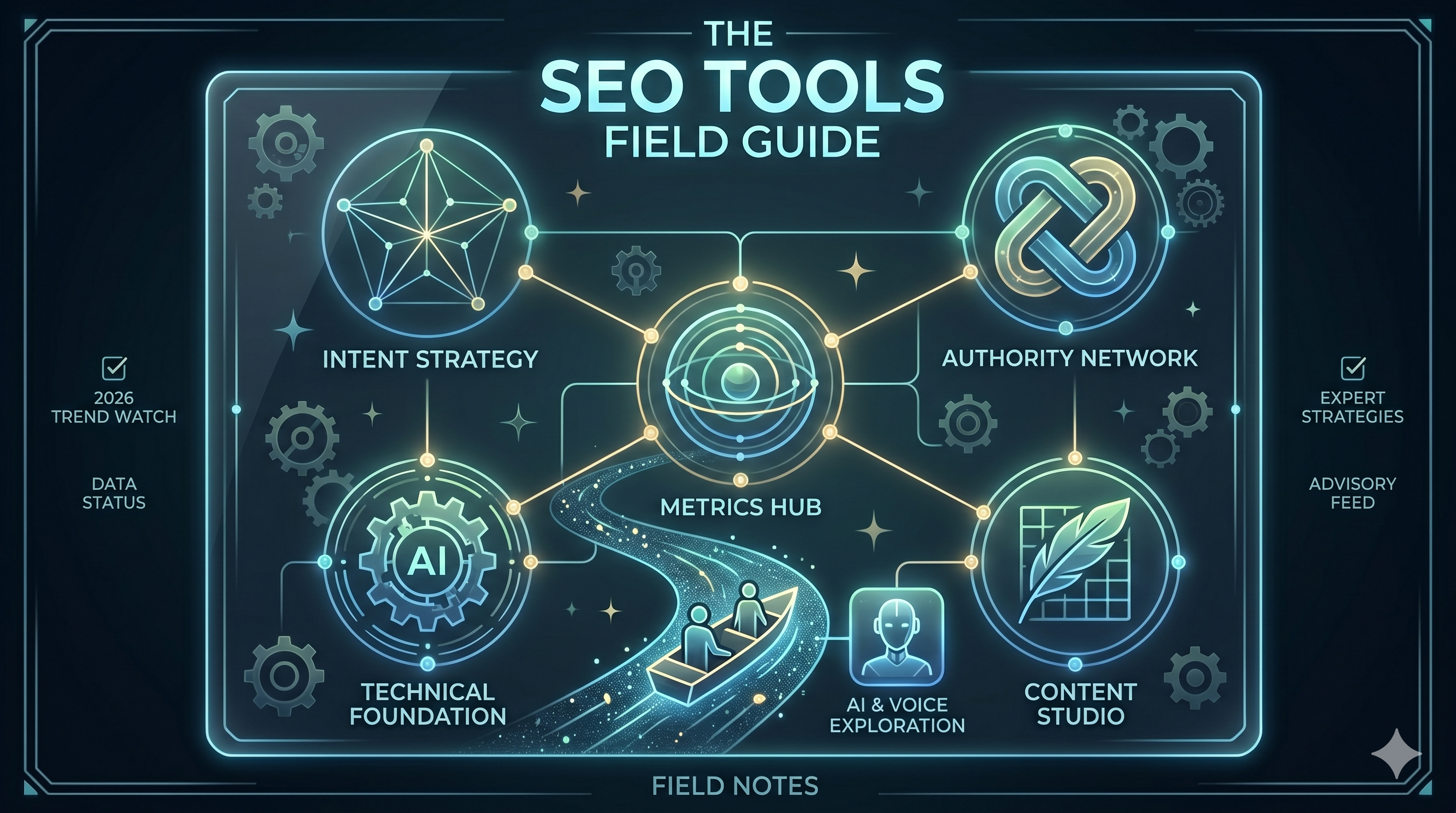
The 2026 SEO Tools Field Guide
Semrush, Ahrefs, Surfer SEO, Clearscope, Frase, MarketMuse, Screaming Frog, Moz Pro — the SEO category has bifurcated into legacy giants and AI-native challengers. Here's the honest map of which to use when.
SEO in 2026 changed shape twice. First Google's AI Overviews ate the click-through rate on informational queries; then 'GEO' (generative engine optimization) appeared as the new sub-discipline of optimizing for ChatGPT, Perplexity, and Gemini citations rather than blue-link rankings. The tools split between the legacy giants that adapted and the AI-native challengers that emerged.
This guide walks the eight tools that consistently appear in real SEO stacks in 2026. The first half is the all-in-one platforms; the second is the specialists worth pairing with one of them. Don't expect a single tool to cover both ranking AND GEO — the workflow is bigger than any one product.
At a glance
| Tool | Best for | Standout | Watch out for |
|---|---|---|---|
| Semrush | All-in-one for marketing teams | PPC + SEO data together | Pricey for small teams |
| Ahrefs | Backlink research + competitor SEO | Best backlink index in the field | Less integrated PPC data |
| Surfer SEO | Content optimization with AI | On-page recommendations + AI writer | Reliance can flatten voice |
| Clearscope | Premium content optimization | Cleanest UX in category | Pricier than competitors |
| Frase | Affordable content + SERP analysis | AI brief generator | Less data depth than premium |
| MarketMuse | Topic-cluster strategy | Topic modeling at scale | Steeper learning curve |
| Screaming Frog | Technical SEO + site audits | The industry-standard crawler | Desktop app, not cloud |
| Moz Pro | SEO basics + domain authority | Easiest onboarding | Less data depth than Semrush/Ahrefs |
1. Semrush — The all-in-one platform for marketing teams
All-in-one SEO suite. Keyword research, backlink analysis, rank tracking, and content audits at enterprise scale.
Semrush is the most complete SEO platform on the market, and the 2026 version added AI-driven content briefs, GEO tracking, and integrated PPC management to the existing keyword and backlink toolkit. It's expensive — but for teams running SEO and PPC together, the integrated data is genuinely worth it.
Best for: in-house marketing teams and agencies running SEO + PPC together.
What it does well: Keyword Magic Tool is best-in-class for keyword research. Position Tracking handles SERP volatility well. The new ContentShake AI handles drafting integrated with the SEO data.
Where it falls short: Pricing tiers escalate fast for multi-domain agencies. Backlink data slightly behind Ahrefs. Interface is dense — there's a learning curve.
Verdict: The right pick when your team needs one platform for SEO and PPC. Pair with Ahrefs if backlinks are the priority.
2. Ahrefs — The backlink and competitor research specialist
Backlink and keyword research platform. The standard for technical SEO and competitor analysis.
Ahrefs differentiates on data quality, particularly backlinks. The 2026 version added AI Content Helper, but the moat is still the index — Ahrefs crawls more pages more often than competitors and the data shows it. For technical SEOs and link-builders, it's the default.
Best for: technical SEOs, link-builders, agencies running detailed competitor research.
What it does well: Backlink index is the largest and freshest in the industry. Site Audit catches issues other tools miss. Content Explorer surfaces what's actually working in any niche.
Where it falls short: PPC data less integrated than Semrush. Pricing tiers gate critical features in ways that frustrate.
Verdict: The right pick for serious technical SEO work. Pair with Semrush if your team also runs paid.
3. Surfer SEO — Content optimization with AI drafting
Content scoring tool. Grades drafts against the top-ranking pages for any keyword in real time.
Surfer is the most popular AI-native content optimization tool, and the 2026 version integrated AI drafting more deeply into the SERP-analysis workflow. Plug in a target keyword, get a content brief based on top-ranking pages, then draft with AI that already knows the optimization targets. The workflow is smooth in a way the legacy tools haven't matched.
Best for: content marketing teams producing optimized articles at volume.
What it does well: The keyword-to-brief-to-draft workflow is the best in the category. NLP-driven recommendations are concrete and actionable. AI writer integrates with the brief.
Where it falls short: Heavy reliance on Surfer's recommendations can flatten distinctive voices. Pricing escalates for high-volume use.
Verdict: The right pick for content teams that need to ship optimized articles weekly. Edit hard before publishing.
4. Clearscope — Premium content optimization with the cleanest UX
Premium content grading platform. Used by enterprise content teams to optimize against search intent.
Clearscope is the premium-priced option in the content-optimization category and earns it on UX. The reports are cleaner than Surfer's, the integration with Google Docs is friction-free, and the team-collaboration features actually work at scale. For agencies and publishers serious about content, it's the boring default.
Best for: content agencies, publishers, in-house teams where editorial workflow matters.
What it does well: Cleanest UX in the optimization category. Google Docs integration is genuinely useful for writer workflow. Reports are interpretable without specialist training.
Where it falls short: Pricier than Surfer or Frase. No AI writer integrated — pairs with separate drafting tools.
Verdict: Right pick for editorial teams where the writers need clean tooling more than they need an AI draft.
5. Frase — Affordable AI-native content + SERP analysis
SERP research and AI content writer. Builds briefs from competing pages and drafts the article.
Frase positions as the AI-first content tool with serious SERP analysis baked in. The price is dramatically lower than Clearscope and the AI brief generator is faster than Surfer's. For solo SEOs and small teams, it's often the right balance of capability and cost.
Best for: solo SEOs, small marketing teams, freelance content writers.
What it does well: AI brief generator is fast and useful. SERP analysis surfaces useful patterns. Pricing is accessible at the solo and small-team level.
Where it falls short: Data depth lags Semrush, Ahrefs, and Clearscope. UX less polished than the premium options.
Verdict: Right pick when budget matters. Upgrade to Clearscope or Surfer when you outgrow it.
6. MarketMuse — Topic-cluster strategy at scale
Topic modeling and content planning. Identifies content gaps via NLP analysis of a site's topic coverage.
MarketMuse plays a different game from the keyword-first tools — it builds topic-cluster maps and tells you what content you're missing relative to authoritative competitors. For sites with hundreds or thousands of pages, the topic-modeling approach scales in ways keyword-by-keyword tools don't.
Best for: large-site publishers, content-strategy leads, SEO consultants doing topic-cluster work.
What it does well: Topic modeling at scale is unique in the category. Content briefs are notably thorough. Inventory features help teams audit existing content.
Where it falls short: Steeper learning curve than the keyword-first tools. Pricier than the average. Less suited to small sites.
Verdict: Right pick for serious topic-cluster strategy work on large sites. Overkill for small blogs.
7. Screaming Frog — The industry-standard technical SEO crawler
Desktop SEO crawler. The standard tool for technical audits of large sites.
Screaming Frog SEO Spider is the technical SEO tool every serious SEO eventually adopts. It's a desktop app, not cloud — but in 2026 that's still the right tradeoff for the deep, configurable site audits this tool performs. The 2026 version added AI-powered features for content categorization and structured data validation.
Best for: technical SEOs, agencies doing client site audits, in-house teams responsible for large sites.
What it does well: Crawl depth and configurability are the best in the field. License pricing is fair compared to cloud-SaaS competitors. The community knowledge base is decades deep.
Where it falls short: Desktop-only workflow doesn't fit cloud-first teams. Steep learning curve for casual users. Output processing requires familiarity.
Verdict: Default for serious technical SEO work. Pair with Ahrefs Site Audit for what each does best.
8. Moz Pro — Easy SEO basics with domain authority pedigree
Backlinks and on-page SEO suite. Less broad than Ahrefs but stronger on Domain Authority methodology.
Moz invented Domain Authority and has been a fixture of the SEO industry for over a decade. The 2026 version isn't as deep as Semrush or Ahrefs on raw data, but the onboarding is gentler and the educational content surrounding the tool is excellent for teams ramping up SEO capability.
Best for: small businesses doing in-house SEO, marketing generalists, anyone newer to SEO.
What it does well: Onboarding is the smoothest in the category. Domain Authority is still a useful (if imperfect) benchmark. Moz Academy teaches the discipline as well as the tool.
Where it falls short: Data depth lags Semrush and Ahrefs. Backlink index smaller. Pricing not dramatically cheaper than competitors.
Verdict: Right pick for SMB SEO when 'we need to start somewhere' describes the situation. Upgrade when you outgrow it.
How to pick
Stacks that work for different SEO roles in 2026:
- Agency SEO consultant: Ahrefs for the research depth, Screaming Frog for audits, Surfer or Clearscope for content delivery.
- In-house enterprise team: Semrush as the primary, Ahrefs for backlink work, MarketMuse for topic strategy, Screaming Frog for technical.
- Solo SEO or freelancer: Ahrefs (lite tier) + Frase + Screaming Frog. Add Semrush only when client work requires it.
- Content-marketing team: Clearscope or Surfer for content, Semrush for keyword data, ChatGPT or Claude for drafting.
- Technical SEO specialist: Screaming Frog + Ahrefs Site Audit + custom dashboards in Google Sheets pulling from APIs.
- SMB doing own SEO: Moz Pro to start, Surfer when content production picks up, upgrade to Semrush when budget allows.
The full SEO Tools branch on AI Tree Library catalogs the rest of the space — schema generators (Schemantra), specialized rank trackers (AccuRanker), and the new GEO-specific tools worth tracking. The Marketing AI branch covers what to do with the keyword research once you have it.